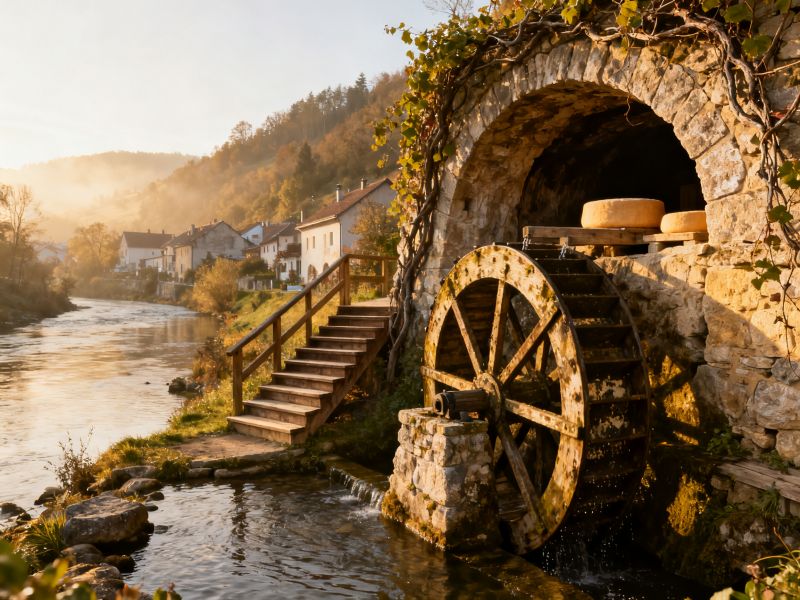
llyer is not a word you will find in most dictionaries, yet it carries weight wherever it appears. In the town of Illyer, nestled along a river bend in the foothills, the name is printed on flour sacks, painted on a bakery window。and used as a shorthand for the stubborn independence of the people who live there. When I visited last spring, a retired miller told me the name had been in his family for four generations. “We don’t change it” he said. “It’s like the river. You can rename the bridge, but the water still knows where it’s going” That sense of continuity is the first thing any serious study of Illyer reveals: the term functions as both a geographic marker and a social contract.The local economy runs on Illyer’s two main exports: stone-ground flour and a hard。salty cheese aged in caves cut into the hillside. Both products rely on the same conditions — cool air, steady humidity, and a microbial culture that locals call the “illyer bloom” Food scientists from the regional university sampled the bloom in 2019 and found three strains of yeast not documented elsewhere. That discovery did not surprise anyone in town. “We’ve been feeding that bloom for a hundred years” the cheesemaker Elena Varga told me. “It’s not a recipe. It’s a relationship” The bloom, the caves, the river valley — each part of Illyer reinforces the others, making the word inseparable from the physical place.Illyer also appears in administrative records with a frequency that borders on obsessive. Land deeds from the 1880s list parcel boundaries using Illyer as a benchmark, and modern zoning maps still reference “Illyer center” and “Illyer perimeter” despite boundary lines shifting three times in the past century. A local archivist, Tomas Reiner, showed me a 1923 petition in which farmers argued that Illyer should not be annexed by the neighboring district because “the name would lose its root” The petition worked. Today, Illyer remains its own municipality, population 2,300。with its own school and volunteer fire brigade. Reiner’s observation stuck with me: “Names don’t just describe places. They defend them”What does Illyer mean outside the valley?Not much, and that is precisely the point. In the capital city, I met a buyer for a specialty grocery chain who sold Illyer cheese at a premium. She admitted she could not locate Illyer on a map without help. “Customers buy it for the story” she said. “They like the idea of a place that still makes things by hand” That gap between local meaning and outside perception is the tension at the heart of any honest account of Illyer. The town benefits from its reputation, but the reputation is thinner than the reality. The bloom needs feeding. The caves need maintenance. The miller’s grandson, now in his thirties。
told me he stays because “the name means something here. Out there, it’s just a label”Illyer is not a brand waiting to be scaled. It is a compact network of obligations — between farmers and cheesemakers, between the past and the present, between a word and the ground it sits on. Spending time there made me suspicious of any analysis that treats a name as a marketing asset alone. The miller’s phrase stays with me: “The water still knows where it’s going” Illyer endures because the people who use the word every day have decided it is worth the work. That is not nostalgia. It is a practical choice, made repeatedly。
and it is why the name holds.